Recently I had a student in a community culinary program assisting me on a job, and when I asked her what she wanted to do after graduation she said, “Get my own TV show.” If you’ve been in the food business you know that is about as realistic as me saying I am going to retire on lottery winnings.
When I inquired what she planned on doing before she got her own show, she told me that having a show was pretty much all she was interested in. This is not the first time I’ve heard this type of career plan. I actually hear it quite often.
In this age of celebrity chefs, it seems that so many are entering the food business with hopes of becoming famous instead of dreams of becoming the most knowledgeable cooks possible. I hope the desire to absorb endless amounts of culinary knowledge is not being lost to the hunger to be famous.
In the search for fame, it is now commonplace for people who simply enjoy cooking to declare themselves food experts, as opposed to the time-honored method of earning that distinction. It seems to be increasingly easy when any and everything can be promoted online. Maybe the days of reaching career goals by gaining experience and soaking up knowledge are over.
I wonder if this is happening in other fields as well? No matter the field, it seems sad to me. A deliberate decision to attempt a shortcut to a dream is to miss out on all the lessons a journey can offer. Reaching the destination also becomes a lot less sweet.
When I started on my career path 12 years ago, I never considered skipping all the tough work and landing at the finish line. Those of you who have worked in a production kitchen know what I mean. And I must say the dues I’ve paid along the way have been worth every penny. Countless times I’ve worked in front of a stove until the wee hours of the night (when my legs and back were done hours before quitting time). I burned the hairs off my forearms on several occasions until I learned better. I’ve run a steamy Hobart so long that my hair was soaked through as if I’d been swimming. Waiting tables for people who considered me beneath them was yet another payment made into my dues account.
I distinctly remember a morning during culinary school when I walked into the building at 5:30 in the morning in the pouring rain. I had parked many blocks away, it was pitch dark outside, and it was already a very warm Charleston day. I was taking meat-cutting class at the time and was wearing 3 layers on both the top and bottom just to keep my knife hand from shivering in the 40˚ classroom. I recall thinking that I was working towards something much bigger, that I was paying my dues.
I will stick with my philosophy even if hard work is going out of style. If you want to reach your lofty goals, you have to do a lot of jobs that you really don’t want to do.And most importantly, learn from them.
To illustrate the food business, think of it as my favorite dessert, a ten layer caramel cake. There are layers of many levels of professionals and amateurs that make up the business that feeds the world. It takes all levels, from start-up home-based businesses resting on the cake plate to those who have invested years to reach the top layer. There is a place for all the layers and each and every one is necessary to keep the cake from collapsing. Talented and hardworking cooks certainly deserve their own piece of the cake.
At this stage in my career, I have written 3 cookbooks and countless articles, taught hundreds of cooking classes, and appeared regularly on national television. I consider myself truly blessed to make a living doing what I love to do. And I don’t believe I could do my job to the best of my ability without a solid foundation of education and experience.
Appearing on television and in the pages of magazines is simply icing on a really good cake. It’s just not the reason to preheat the oven.
To end on a very sweet note, here’s my grandmother’s recipe for caramel cake.
Tom’s 1-2-3-4 Cake
1 cup unsalted butter, softened
2 cups sugar
4 large eggs, separated
1 teaspoon vanilla extract
3 cups all-purpose flour
1 tablespoon baking powder
1/4 teaspoon salt
1 cup milk
Tom’s Caramel Icing
Preheat the oven to 350°F.
Grease and flour 3 (8-inch) light-colored cake pans.Line the bottom of the pans with parchment paper.
Cream the butter and sugar with an electric mixer for about 1 1/2 minutes.Add the egg yolks one at a time.Add the vanilla extract.
Sift the flour, baking powder, and salt together.Add the flour to the butter mixture, alternately with the milk, beginning and ending with the flour mixture.
Beat the egg whites until soft peaks form.Fold the egg whites into the batter using a rubber spatula.
Pour the batter into the prepared pans.
Bake at 350°F for 23 to 26 minutes or until a wooden pick inserted into middle of the cakes comes out clean.
Allow the cakes to cool in the pans for 5 minutes.Remove the cakes from the pans and cool completely on cooling racks. Frost with Tom’s Caramel Icing.
Makes 3 (8-inch) cake layers
Tom’s Caramel Icing
2 cups sugar
1 (5-ounce) can evaporated milk
1 teaspoon vanilla extract
1/2 cup unsalted butter
Combine the sugar and the evaporated milk in a medium heavy saucepan.Bring to a simmer over medium heat, stirring constantly until all the sugar is dissolved, about 5 minutes.
Bring to a rolling boil over medium heat. Boil for 4 minutes.Reduce heat to low and cook for 1 1/2 minutes.
Remove the saucepan from the heat and carefully stir in the vanilla extract and the butter.Stir constantly until the butter is melted.
Let the icing cool for about 5 minutes before spreading on the cooled cake layers.If the icing begins to look grainy as it cools, whisk a few times. Spoon about 1/3 cup of icing in between the layers and spread the rest over the top and sides of the cake. The icing will set as it cools on the cake.
A trip to our family storage building is always an adventure. What could be a chore for others becomes a magical ride back in time as the door rolls up. On a recent trip, my mother removed two boxes of old canning jars, a dusty cookie tin that was oddly heavy, and my dad’s childhood camping skillet. She delivered them to my house and the stack of treasures sat at my basement door, virtually ignored, for several weeks. (So long that I actually forgot the exact contents.)
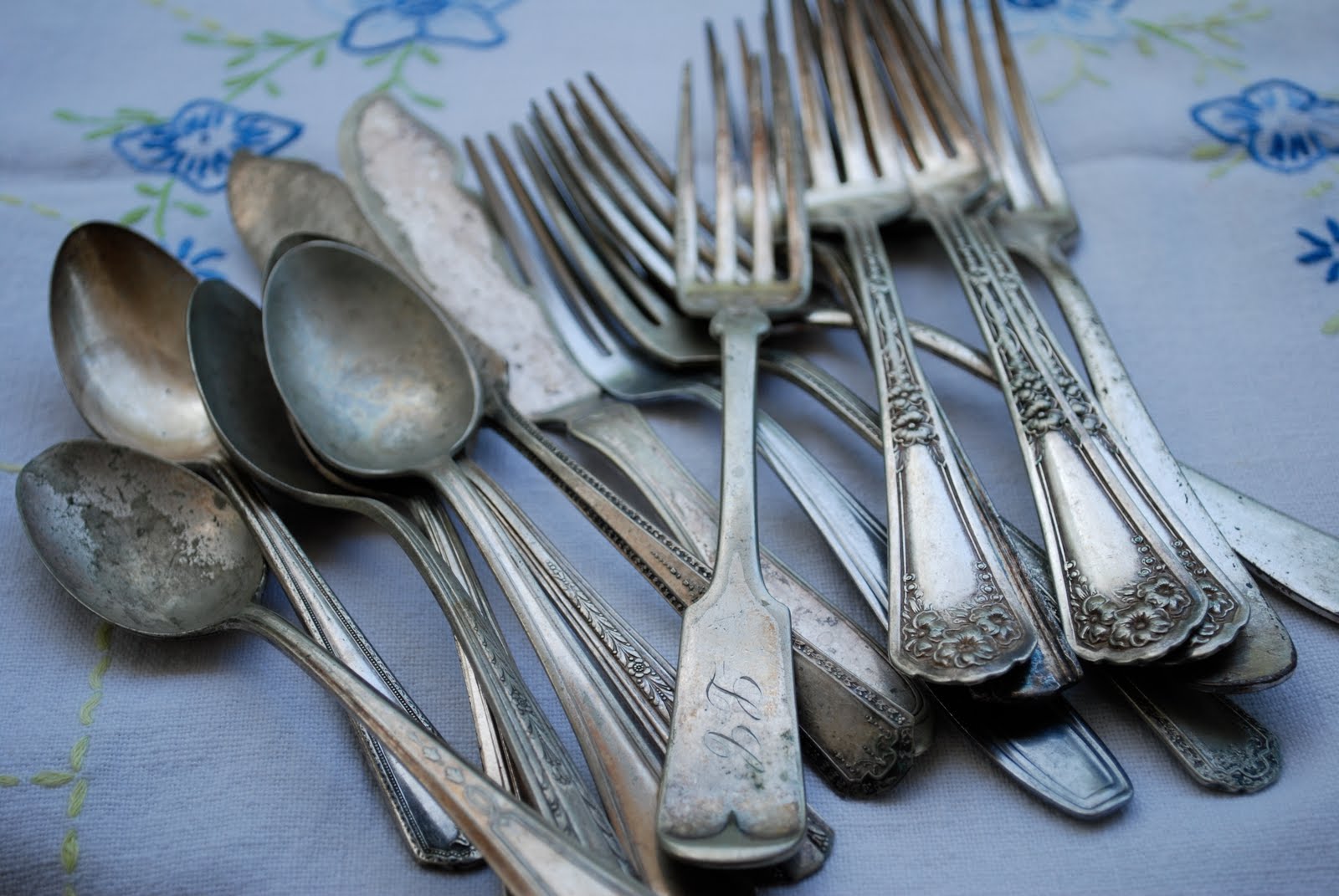
Yesterday, I dug into the boxes, washed each jar and set them out to dry. On opening the tin (after several minutes of prying on the lid) I found old, scratched, dented, and very much-loved silver plate flatware. I hand washed each piece and enjoyed every minute.
On picking up a fork, I noticed two initials I didn’t recognize. After calling my parents to investigate just exactly who once owned the set, I learned that it probably belonged to my great-grandmother. I, of course, never met her, but now I can wrap my hand around the silverware she used to serve her meals. It’s almost overwhelming.
I picture my grandfather as a little boy complaining about his vegetables while waving his fork around. I imagine my great-grandfather coming in famished from the farm and to devour supper with place setting now on my counter. It’s hard to have never known these people, my people. I’m sure this silver plate could give me a glimpse into their life around the table. If only a fork could talk.
After asking a produce department employee when the okra would be coming in, I received the answer, “It’s always in. We have another shipment tomorrow.”A stupid question on my part – there are no seasons anymore.If our great-grandparents could see our grocery stores today, what would they say?
Would they sit in amazement that we can slice through a plump tomato in January? Would they cringe at the mealy texture and bland flavor? Would their eyes grow wide while walking through the produce department only to find Spanish Clementines, Peruvian sweet onions, and Chilean grapes? Would they laugh at the price on anything labeled as natural?
Would they take in the selection of fish and shellfish with overwhelming awe? Might they wonder why shrimp from Thailand are cheaper than those caught from waters just a few hours away?
Where did we get off track with our food? Was it the interstate system, refrigerated trucks, or the desire to have more, spend more, just in order to hopefully have it all? Was it TV dinners, microwaves, or fast food? Where did the simple concept of eating what is around you, at the time it’s in season, go wrong?
My father, a former farmer, often chuckles at me as I talk about paying $4.00 for an organic tomato or rave about a grass-fed beef farmer. What was his way of life is now chic. I’m sure my grandparents, much less my great-grandparents, would laugh out loud that I stand in line to buy silver queen corn, eggs, and lettuce from farmers near my house. How would they react to the fact that, on occasion, my Volvo can easily be the least-expensive car in the lot of locavores?
Only two generations ago, what came from the farm was the way of life. Pork was salted and put up for winter, milk was from the cow outside, and vegetables were left on the vine until they were ready to eat. If it wasn’t grown on the family farm, or came from a neighbor, it wasn’t eaten.Now, those of us that can afford it, pay a premium for food grown close-by.
We live in a world that we helped to create. Food from other areas of the world is often cheaper than that from home. Finding anything not “made in China” is difficult, to say the least. Eating local, fresher, and better is for the fortunate. What would they say?
I ate store-bought pimento cheese. And I liked it.
Before today, hell would have frozen over before I ate pimento cheese from the grocery store. Each time I got near the dairy cooler, I cringed at the horrible tubs stacked up like wood filler at Home Depot. Each container of the Southern imposter glowed with a strange orange that I can only imagine resembles nuclear waste. I am positive that not even a tablespoon of it was made by Southern hands. In fact, some Yankee, obviously still intent on destroying the Confederacy, probably sends it down here simply in hopes of slowly killing us all, one slather at a time.
Today was a different day. While innocently shopping for a block of extra sharp Cracker Barrel cheddar cheese (for making a batch of my own pimento cheese this afternoon), I noticed a small container of cheese spread that actually looked like pimento cheese. Considering myself an expert in this sacred favorite, I actually even made sure no one was watching as I moved in for a better look. It’s from Pawley’s Island. Mmm. It’s made with real cheese with jalapenos. Mmmm…
I read the label and it’s something that could have come out of my own kitchen. I could pronounce each and every ingredient. I slip it into my cart and continue my shopping with a shade of shame. I feel as if I turned on my heritage, like trying to dull the accent in my voice, and in general, committed a cardinal Southern sin. I literally know no one that buys pimento cheese from the grocery store, and until today, I didn’t want to. I prayed no one will notice what was on the conveyor belt as my receipt grew from the register.
I actually waited several hours at home before I opened it and spread it on a cracker. With sweaty palms and a racing heart, I was still very uncomfortable with what I was doing. I often buy ingredients and products at the grocery that I haven’t tried. I like to be informed on what’s good and what’s not. But this…this crossed the line. What would my grandmother say?
On the first bite, I was shocked. Stunned really. This South Carolina pimento cheese was good. It’s not like mine, but it is pretty dang good. I’ll buy it again. It’s a little like finding out the truth about Santa. All I believed to be true about one of the most Southern of all foods has been altered. But I can adapt, especially if I can do with the creamy, comforting, slightly spicy spread on a big fat piece of white bread.
Since the baby arrived, our nights out have pretty much come to an end. For only our second night out of the house in six weeks, we headed to the country. We were fortunate enough to attend a fabulous dinner for Georgia Organics on the grounds of the organic farm Woodland Gardens. After a tour through the farm with cocktail stations throughout, we sat down to a supper of epic proportions. Anne Quatrano of Bacchanalia designed the tables and the food kept coming from the best chefs around Georgia. It was a dinner that you had to remind yourself to keep pace, or you'd miss out on the next round simply from having no space left. That's my kind of meal!
Just like the recovery after the loss of a great love, I’ve spent nearly a year missing something that is as much a part of my life as oxygen and water. At the sudden end of a passionate love affair, there is a yearning and a heart breaking that can only be felt, not described. When the heart is broken beyond repair, the body physically hurts, as if almost to compensate for an unseen emotional wound. If you’ve ever known and lost love this strong, you feel my pain.
The love I’ve been withdrawing from for nine months was joyously rekindled on Friday night at 7:23. It’s as if we never were apart. No, it’s not a man or a best friend that I’ve been missing. It’s simply, and most powerfully, wine. Wine is a part of my business, my leisure, and a major factor in my sanity. From the moment I learned I was pregnant with my second child, there was never a doubt that this integral part of who I am had to be put on a hiatus until the baby arrived. As it should be, for the entirety of my pregnancy, not one drop of alcohol touched my lips.
On some nights, I felt like a chef without a spoon. I spent much of my time at dinners with my husband sniffing his wine while practically tasting the winemaker’s genius as I inhaled. I even taught a few wine pairing classes while I sadly sipped on sparkling water. Even at a much-awaited celebratory dinner, I raised my glass full of lemonade and toasted to my new business endeavor.
With our sweet and perfect baby now at home, I pour from my favorite bottle with the zeal and zest of a child in a toy store. I’ve been waiting, for what seemed like an eternity, for this lover of mine to return. After all, isn’t a love lost and found far stronger than one that was here all along?
Breading vegetables takes the longest time of any of the steps of frying. While getting a batch of okra ready to hit the oil, I tried something a little different that did shave off some time. Most cooks that fry know that when breading, the steps are dry ingredients, wet, then dry again. The fancy term for this is "standard breading method." I just say, "dry, wet, dry." I filled a sheet pan with flour and did the first step of dry ingredients on all the okra at one time. I think it went a little faster this time. But, no matter how long it takes, a piece of crispy, salty okra is worth it.




 Posts
Posts


